Why not the Eco-Dismissers?
The least engaged group accounts for two-thirds of FMCG spending in the region
For years, the sustainability discussion has focused on consumers who have already turned awareness into action. Nonetheless, in 2025, our analysis indicates the opportunity lies in looking to the other side of the spectrum: the Eco-Dismissers.
This group represents 40% of Latin Americans, accounting for € 31.8 billion in FMCG spending across the region. Nonetheless, only 3% of them manage to perform sustainable actions effectively. This gap highlights the size of the challenge, as well as the potential for transformation.
Despite their distance from the sustainability narrative, Eco-Dismissers are not indifferent to the world: 20% express concern about fake news (vs. 21% regional average), 12% about racial inequality (vs. 14%), and 13% about gender inequality (vs. 14%).
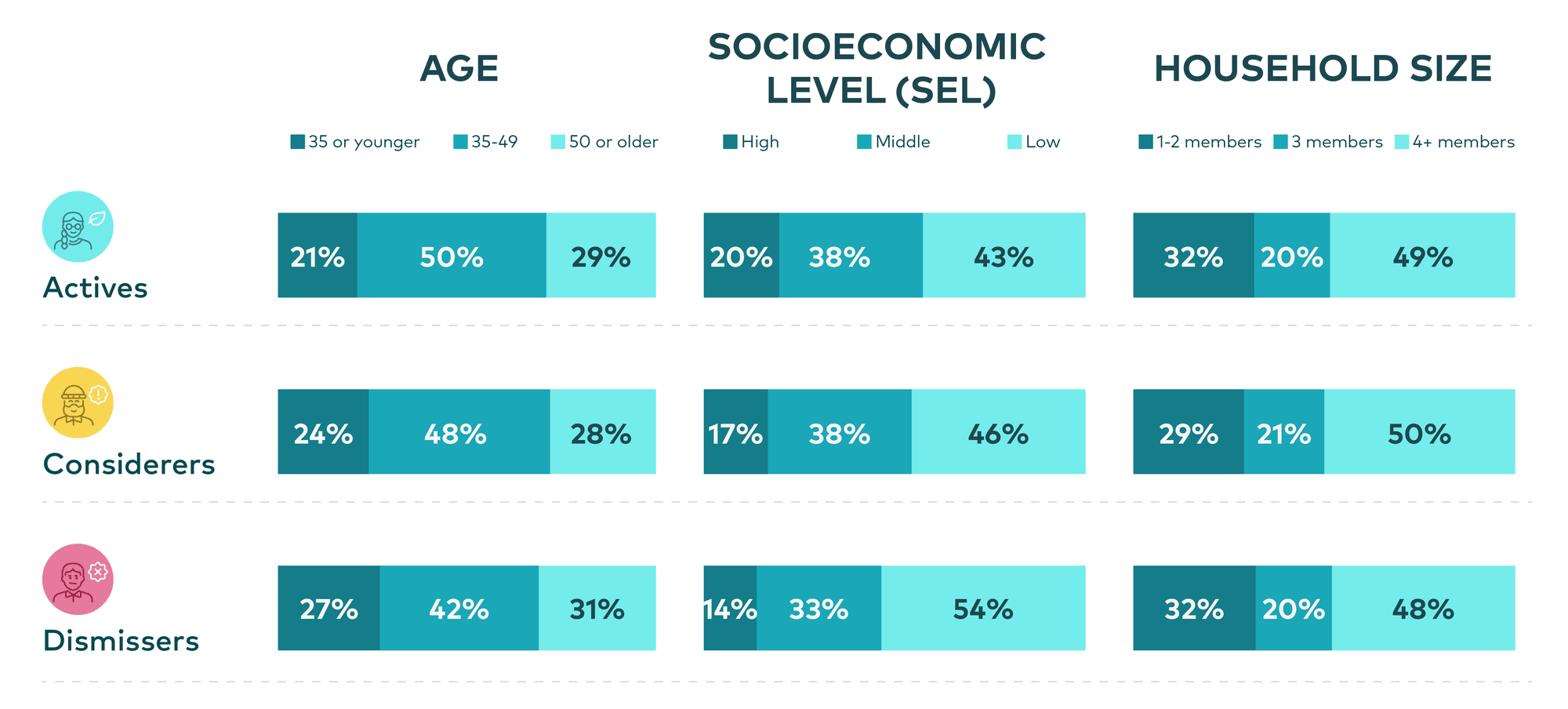
This means it is not a lack of interest, but rather the difficulty mentioned earlier in this study — along with different priorities. So much so that our data show that this group does not differ from the others in terms of age or household size. The only contrast lies in the socioeconomic level (SEL).
The good news is they are open to learning and trying. Looking at purchase categories, 31% of Eco-Dismissers say they either have never bought products with recycled packaging materials but would like to, or do not know exactly what those are. The same applies to locally-sourced ingredients (34%). This indicates latent curiosity and room for education and accessible communication.
Recycling remains another major challenge: 47% of Latin Americans in this group do not understand the recycling process at home, 47% do not understand labels, and 51% do not know what to do with biodegradable packaging. As a result, recycling practices are low — 64% never or seldom recycle batteries, 58% glass, and 55% aluminum.
The path forward, therefore, is clear: it is time to understand and include the Eco-Dismissers. The small interest they show today could be the starting point for a behavior change — and for a new cycle of sustainable growth in Latin America.